Humanoid Hanoi: Investigating Shared Whole-Body Control for Skill-Based Box Rearrangement

Accepted at CoRL 2026!
Contributed equally
Collaborative Robotics and Intelligent Systems Institute
Oregon State University

Abstract

We introduce Humanoid Hanoi, a challenge problem for long-horizon humanoid skill composition that requires a robot to repeatedly sequence pickup, locomotion, and placement skills to rearrange stacked boxes in simulation and on hardware. This symbolically simple task exposes a weakness in a common modular humanoid architecture, where reusable high-level skills are learned on top of a shared, task-agnostic whole-body controller (WBC). While such a WBC provides a unified low-level interface for skill composition, it may not be sufficiently hardened to execute the full collection of learned skills under domain randomization and long-horizon closed-loop execution. We compare task-agnostic strategies for addressing this issue, including skill-specific WBC fine-tuning, residual low-level adaptation, and a rollout aggregation procedure that augments shared-WBC training with closed-loop rollouts from each individual skill under domain randomization. Our experiments show that the strongest long-horizon robustness is achieved not through skill-specific specialization, but by incrementally expanding the closed-loop coverage of the shared WBC while preserving its original task-agnostic tracking objective. Results in simulation and on the Digit V3 humanoid demonstrate improved long-horizon robustness and suggest that preserving low-level controller consistency can be as important as improving individual skills.

Shared WBC Architecture

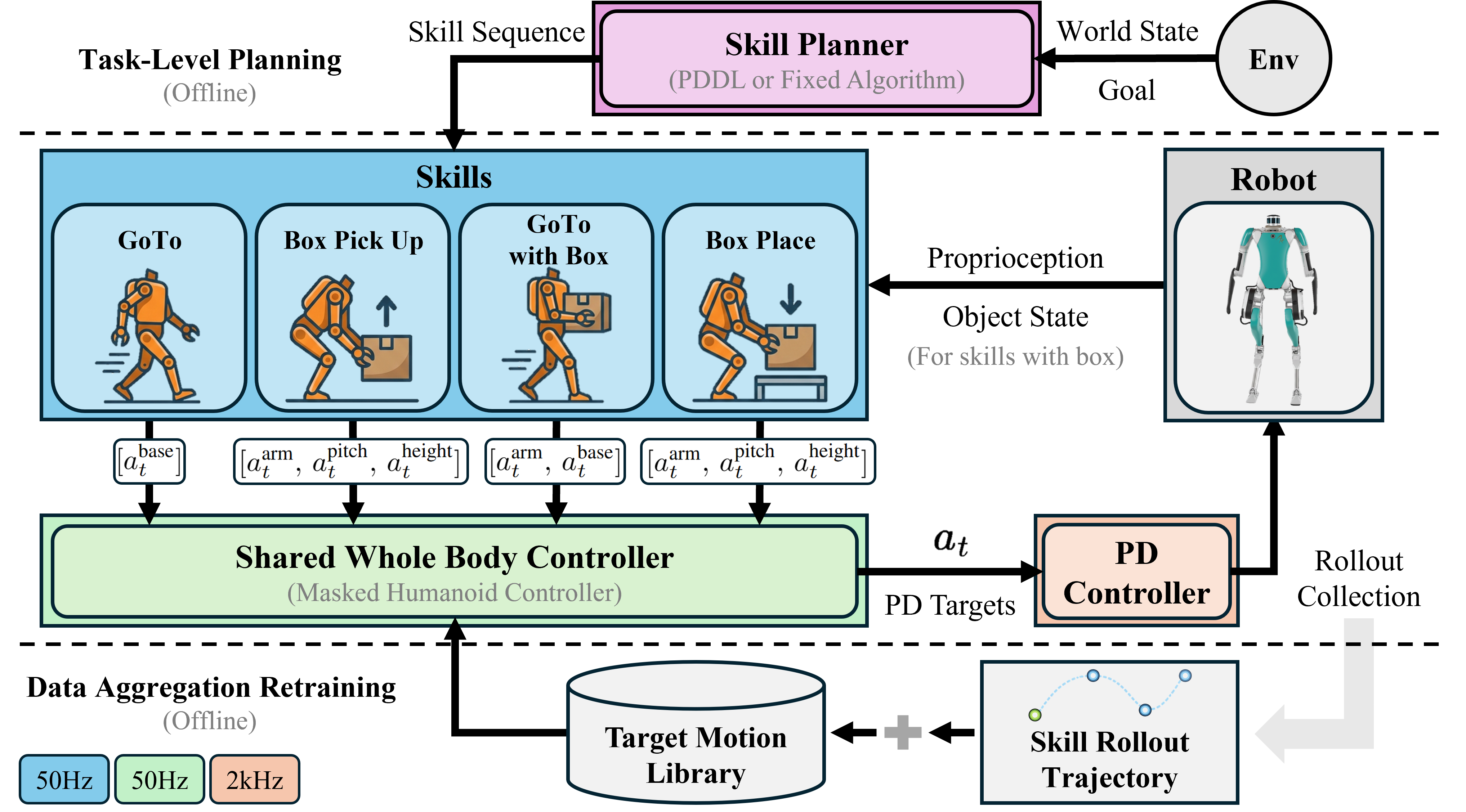
Our architecture uses a shared, task-agnostic whole-body controller (WBC) that executes all skills through a unified low-level control interface. This enables skill reuse and simplifies composition without switching control laws at skill boundaries. Independently trained high-level skills generate task-level commands that are executed through the shared WBC, which produces joint-level PD targets tracked by a low-level PD controller on the robot.

We extend this architecture with a rollout-based coverage expansion method: closed-loop rollouts from each individual skill under domain randomization are aggregated to further train the shared WBC. This procedure expands the controller's state-command coverage, improves robustness over long horizons, and preserves the original task-agnostic tracking objective and a consistent low-level interface across skills.

System overview of the shared WBC architecture

Humanoid Hanoi Simulation Success

Humanoid Hanoi Simulation Failure

Hardware Pickup and Place Skills

Robust over different target heights, target positions, box masses, and box dimensions.

Humanoid Hanoi Hardware Success

Configuration 1
Configuration 2
Configuration 3

Humanoid Hanoi Hardware Failure

Perception and box state estimation error
Localization error
Physical interaction during placement
Unstable stand

Two-Tower Hardware

Simplified two-tower hardware setup used to reduce yaw-localization demands. The robot completes five consecutive three-box stacking trials before stopping due to motor heating.

BibTeX

@article{kim2026humanoid,
      title={Humanoid Hanoi: Investigating Shared Whole-Body Control for Skill-Based Box Rearrangement},
      author={Kim, Minku and Chen, Kuan-Chia and Shrestha, Aayam and Fuxin, Li and Lee, Stefan and Fern, Alan},
      journal={arXiv preprint arXiv:2602.13850},
      year={2026}
    }